Introduction: The Multi-Channel Music Business
Global recorded music revenues hit $31.7 billion in 2025. Spotify alone paid out more than $11 billion to rights holders in a single year — the largest payout in the history of the music business. Independent artists and labels claimed half of that total.
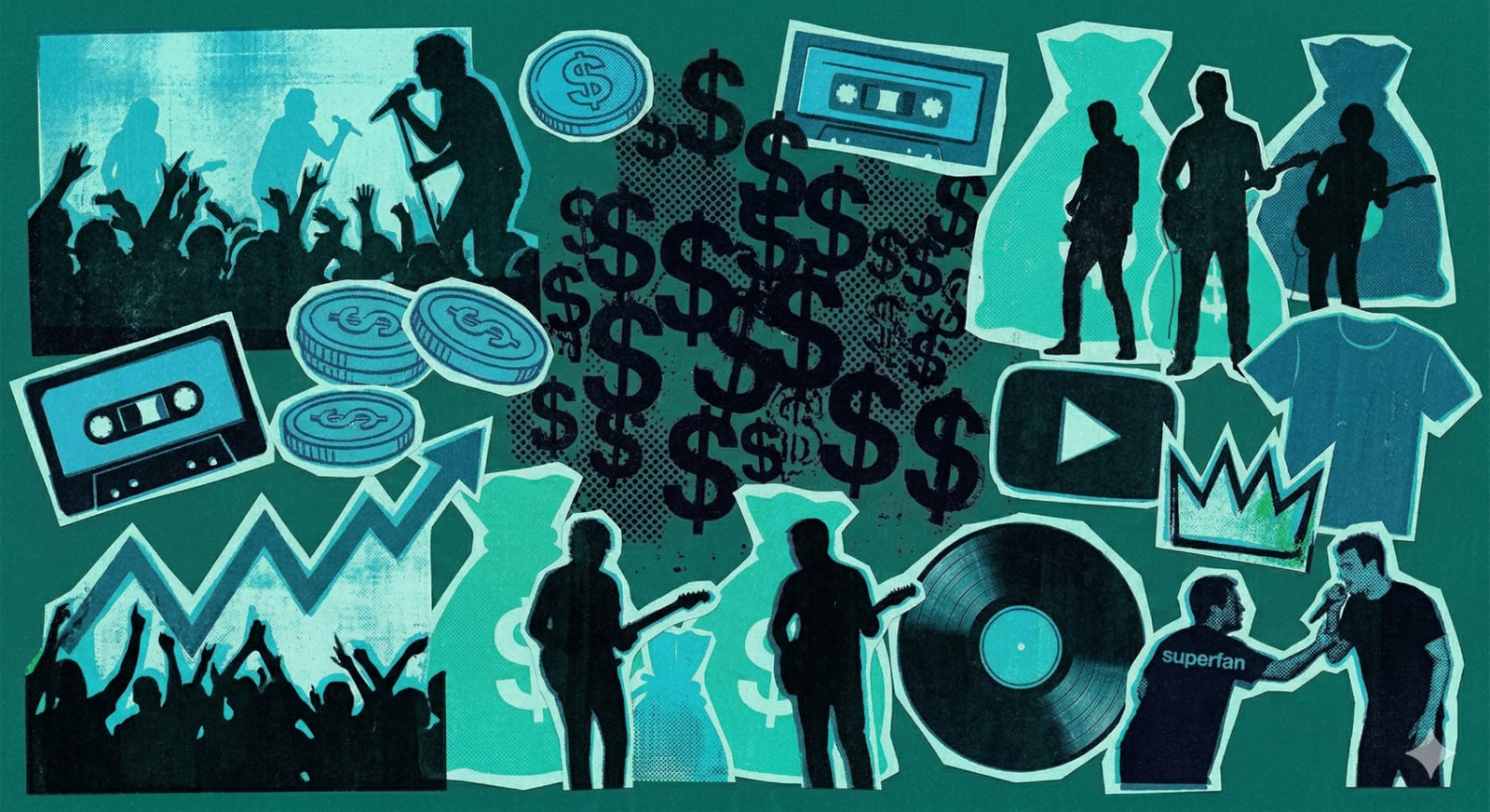
And yet the majority of independent musicians are not making a sustainable living. Not because the money isn't there. But because most artists are drawing from just one or two wells in a landscape that now offers fourteen or more distinct income streams — many of which require nothing more than a one-time registration to activate.
The artists thriving in 2026 are not necessarily the most famous or the most streamed. They are the ones who have built layered, diversified income architectures. They understand that streaming is a visibility engine, not a salary. That live shows are just one of many ways to monetise audience attention. That intellectual property — a catalogue of original songs — is an asset that can generate income in a dozen different ways simultaneously, long after the music was made.
This playbook covers every viable income stream available to artists and musicians in 2026. For each, you will find what it pays, how much effort it takes to activate, whether it scales passively, and exactly how to maximise it. Read it as a menu. Start with the streams you are not yet using. Build toward owning all of them.
The top 1% of artists on Spotify capture 90% of all streams, leaving the vast majority earning less than $10,000 annually from that platform alone. But artists who diversify across just four to six income streams consistently report 2–4x the total income of those relying on streaming alone. Diversification is not optional in 2026 — it is the strategy.
The Revenue Matrix — 14 Income Streams at a Glance
Use this table as your master overview. Detailed breakdowns for every stream follow in the sections below.
| Income Stream | Earnings Potential | Effort to Start | Passive? | Priority |
|---|---|---|---|---|
| Streaming royalties (master) | Low/stream; scales with volume | Low — just distribute | Yes | Foundation |
| Publishing royalties | 30–50% on top of streaming | Low — register once | Yes | Essential |
| Live performances | High — main income for many | Medium | No | Core |
| Merchandise | High margins at scale | Medium | Partly | Core |
| Sync licensing | $500–$200k+ per placement | Medium–High | Yes | High-value |
| YouTube / Content ID | $0.001–0.003/view; scales | Low — set up once | Yes | Passive |
| Fan subscriptions | $5–50/fan/month | Medium | Partly | High-value |
| Brand deals & sponsorships | $1k–$500k+ per deal | High — relationship-based | No | Scale-dependent |
| Physical music sales | High margin / unit | Medium | Partly | Niche loyal fans |
| Beats & sample packs (producers) | Passive catalog income | Medium | Yes | Producer-specific |
| Session work & production fees | $500–5k+ per session | Low — network-dependent | No | Consistent income |
| Teaching & masterclasses | $30–$300/hr or course revenue | Low–Medium | Partly | Stable |
| Crowdfunding | Project-by-project | High — campaign-intensive | No | One-time boost |
| Grants & public funding | $1k–50k+ per grant | High — application-based | No | Underused |
Income Stream 1: Streaming Royalties
Streaming is the foundation of the modern music economy — not because it pays well per play, but because it works constantly, reaches globally, and drives every other income stream. Think of streaming as top-of-funnel: it puts you in front of new listeners who then buy tickets, merch, memberships, and everything else on this list.
At an average of $0.003–$0.005 per stream on Spotify, you need approximately 200,000 streams per month to earn $600–$1,000 in master royalties alone. That is modest as a standalone income. But as the engine that fills your other revenue channels — it is irreplaceable.
Per-platform rates (2026 averages)
| Platform | Avg. per stream | Model | Notes |
|---|---|---|---|
| Spotify | $0.003–$0.005 | Pro-rata | Largest user base globally; strongest for discovery |
| Apple Music | $0.007–$0.010 | Pro-rata | Premium-only; higher rate per stream |
| Tidal | $0.012–$0.015 | User-centric | Highest average rate; smaller audience |
| Amazon Music | $0.004–$0.008 | Pro-rata | Growing; strong in smart speaker usage |
| YouTube Music | $0.001–$0.003 | Pro-rata | Lower rate due to ad-supported tier |
| Deezer | $0.004–$0.006 | User-centric | Pioneer of user-centric model; EU-strong |
How to maximise streaming income
- Release consistently — every 4–6 weeks keeps you in Release Radar and algorithmic playlists
- Pitch to Spotify editorial at least 4 weeks before release via Spotify for Artists
- Optimise your artist profile as a conversion funnel: strong bio, Canvas videos, pinned release
- Collect BOTH master and publishing royalties from every stream (see Stream 2)
- Focus on listener-to-follower conversion, not raw play counts
1 million Spotify streams generates approximately $3,000–5,000 in master royalties after distributor fees. That same catalogue, fully registered for publishing, generates an additional $800–1,200 in mechanical and performance royalties. Streaming alone is insufficient as an income model. It is the discovery layer that powers everything else.
Income Stream 2: Publishing Royalties — The Most Uncollected Money in Music
Publishing royalties are the single most underutilised income stream in independent music. Every time your song is streamed, played on radio, featured in a YouTube video, or performed live, TWO separate payments are generated: one for the master recording (which flows through your distributor) and one for the composition (which flows through your PRO and mechanical rights body). Most independent artists only receive the first payment. The second — which can add 30–50% on top of your total streaming income — goes uncollected simply because the artist never registered.
The four publishing royalty types
| Royalty type | Trigger | Collected by | Rate (US, 2026) |
|---|---|---|---|
| Mechanical | Every stream / download | The MLC (US); publisher admin globally | ~15.3% of platform revenue |
| Performance | Stream / radio / live / TV | Your PRO (BMI, ASCAP, PRS etc.) | 50% songwriter + 50% publisher |
| Sync (publishing) | Music in film/TV/ads | You or your publisher | Negotiated per placement |
| Sheet music sales | Publisher or self | Small; relevant for composers |
The three registrations you cannot skip
- Join a PRO in your territory (BMI or ASCAP in the US; PRS in UK; BUMA/STEMRA in NL) and register as both songwriter AND publisher. Self-publishing = collecting 100% of both halves.
- Register each song with The MLC (themlc.com) to collect US streaming mechanical royalties. Free to join. Without this, mechanical royalties from every US stream are uncollected.
- Sign with a publishing administrator (Songtrust, CD Baby Publishing, or equivalent) to collect royalties internationally. Without international registration, you miss royalties from Germany, Japan, Brazil, and every other territory your PRO doesn't directly reach.
At 1 million streams: master royalties ≈ $3,500. Publishing royalties (mechanical + performance, fully registered): ≈ $900–1,200 additional. At 10 million streams: master ≈ $35,000. Publishing adds ≈ $9,000–12,000 on top. This is money that already exists — it just needs to be claimed.
Income Stream 3: Live Performances
For the vast majority of working musicians, live performance is still the largest single source of income. It is the income stream that scales most directly with audience size, that generates the most immediate and tangible fan relationship, and that opens the door to every other revenue stream — from merch to brand deals to recording opportunities.
Live performance income in 2026 goes well beyond the show fee. The modern live income model has multiple layers, each stackable on top of the performance itself.
Every revenue layer inside a live show
| Revenue layer | What it is | How to maximise |
|---|---|---|
| Show fee / guarantee | Negotiated payment from venue or promoter | Raise with each booking; track attendance data |
| Ticket sales (co-promote) | Share of door revenue if co-promoting | Negotiate co-promoter deals as you grow |
| Merchandise at show | Physical sales at merch table | $5–15 merch revenue per head in engaged crowds |
| VIP packages | Meet-and-greet, soundcheck access, signed items | Add 1–3 tiers to every ticketed show |
| PRO live royalties | Royalties for performing your own songs live | Submit setlists to your PRO after every show |
| Festival fees | Guaranteed fee from festival organisers | Targets: local first, then regional, then national |
| Private events | Corporate, wedding, private bookings | Often higher fees than public shows |
| Live recordings | Live album, EP or single from recorded shows | Monetise the performance again after the night |
Many artists overlook the PRO royalties for live performance. Every time you perform your original songs at a venue, the venue pays a blanket licence to your PRO. That money is then distributed to registered songwriters based on setlist data. Submit your setlist after every show — it is a ten-minute task that generates passive income from work you have already done.
Live income becomes truly sustainable once an artist can reliably draw 200–500 paying attendees per show. At $15 average ticket + $8 average merch spend, 300 attendees generates $6,900 per night. Three shows per week at that level is a full-time income from live alone — before streaming, sync, or any other source.
Income Stream 4: Merchandise
Merchandise is one of the highest-margin income streams available to artists with engaged audiences — and one of the most consistent ways to turn fan loyalty into direct revenue. A Spotify stream pays a fraction of a cent. A fan paying $35 for a hoodie is worth roughly 10,000 streams in a single transaction.
In 2026, merchandise has expanded well beyond the classic T-shirt and poster model. The most successful artist merchandise programmes operate as full product ecosystems — combining physical items, limited edition drops, digital goods, and fan-exclusive items that superfans actively seek out.
The merchandise categories that convert
- Apparel: T-shirts, hoodies, hats. The evergreen core of any merch programme. High margin, wearable advertising.
- Vinyl: The top merch choice across almost every genre according to a Spotify fan study. US vinyl sales grew 8.6% year-on-year in 2025, reaching 47.9 million units. Limited pressings and colour variants drive urgency.
- Limited edition drops: Scarcity creates demand. Time-limited or quantity-limited drops generate more per-unit revenue than open catalogue items.
- Cassettes: A resurgent format with strong collector appeal, especially in indie and alternative genres.
- Signed / personalised items: Signed physical products, personalised messages, and custom art command premium prices from superfans.
- Digital merchandise: Stems, alternate mixes, unreleased demos, hi-res downloads — no production cost, 100% margin.
- Art prints and photography: Especially effective for visually-driven artists and those with strong visual branding.
Where to sell merchandise
| Platform | Commission | Best for | Key advantage |
|---|---|---|---|
| Bandcamp | 15% (drops to 10% after $1k sales) | Independent artists | Fan-direct; Bandcamp Friday zero-fee days |
| Your own website | 0% + payment processing (~3%) | All artists | Full margin; email capture; brand control |
| Shopify | 0% + subscription + payment fees | High volume artists | Full e-commerce; integrates with everything |
| Printful/Printify | Print-on-demand; no inventory | New artists | Zero upfront cost; lower margin |
| Merch at shows | 0% (pay production cost) | All touring artists | Highest conversion; impulse buy environment |
Income Stream 5: Sync Licensing
Sync licensing — placing your music in film, TV, advertising, video games, and other visual media — is the highest per-placement income opportunity available to independent artists. A single well-placed track can earn more than a year of streaming income, paid upfront and immediately.
The sync fee is split 50/50 between the master recording owner and the publishing rights holder. If you own both — which you do as an independent artist who self-releases — you receive 100% of the total sync fee. This is the most powerful financial argument for retaining ownership of both your masters and your publishing.
Sync fee ranges by placement type (2026)
| Placement type | Fee range | Notes |
|---|---|---|
| YouTube / online video | $50–$500 | Volume-based; good for building a sync track record |
| Podcast / podcast ad | $100–$1,000 | Growing market; recurring use fees possible |
| Independent film | $500–$5,000 | Lower fees but strong portfolio value |
| TV episode (cable/streaming) | $2,000–$15,000 | Recurring backend royalties for each broadcast |
| TV episode (major network) | $5,000–$30,000 | Significant fees + strong performance royalties |
| National TV commercial | $15,000–$150,000+ | Major brands; life-changing placements |
| Major film (background) | $5,000–$30,000 | Less than feature use but strong association value |
| Major film (feature use) | $20,000–$200,000+ | Feature use in key scene; career-defining |
| Video game | $2,500–$50,000+ | Growing market; often includes backend royalties |
How to get sync placements
- Music supervisors: build relationships with the professionals who curate music for productions. Attend industry events, send clean EPKs, and ensure all rights are cleared.
- Sync libraries: platforms like Musicbed, Artlist, Epidemic Sound, and Musicbed license music to content creators. Lower fees but passive, recurring income once listed.
- Publishing administrator: services like Songtrust have sync networks and actively pitch catalogues. Not a replacement for direct relationships but a scalable supplement.
- Proactive pitching: identify upcoming productions through IMDB Pro, trade publications, and music supervisor directories. Personalised, targeted pitches have dramatically higher success rates than mass submissions.
If your music contains any uncleared samples — drum loops, vocal chops, interpolations, or any other element you do not own the rights to — it cannot be sync-licensed. Music supervisors require a clean chain of title. Uncleared samples are the single most common reason sync deals fall apart. Make sync-ready, sample-free tracks a standard part of your production workflow.
Income Stream 6: YouTube & Content ID
YouTube generated $2.5 billion in creator earnings from Content ID alone in 2023, with TikTok's commercial music library paying a further $458 million to rights holders that year. Together, these platforms represent a significant and largely passive revenue stream for artists who set up monetisation correctly.
Two YouTube income layers for artists
- YouTube Content ID: when any YouTube video uses your music, Content ID detects the match and routes advertising revenue from that video to you. Set this up through your distributor (DistroKid charges 20% commission on Content ID; LANDR and others offer it as part of their subscription). Once active, it runs automatically across billions of videos.
- YouTube channel ad revenue: if you maintain your own YouTube channel and join the YouTube Partner Programme (requires 1,000 subscribers and 4,000 watch hours), you earn ad revenue directly from your own video content. Music videos, studio vlogs, live performances, and behind-the-scenes content all qualify.
YouTube pays a higher per-stream rate for videos watched by Premium subscribers and a lower rate for ad-supported views. The average effective rate per music stream on YouTube Music is $0.001–$0.003, notably lower than Spotify — but the Content ID system means you earn from a much broader universe of content that uses your music, not just direct streams.
The power of Content ID is that it scales with your catalogue and with the internet's use of your music — not just your own promotion. A 2015 track that a fitness influencer uses in a workout video in 2026 generates income you would never have thought to capture. Set it up once and let it run across your entire back catalogue.
Income Stream 7: Fan Subscriptions & The Superfan Economy
The superfan economy is the fastest-growing segment of the music business. Goldman Sachs estimates the global superfan market at $4.5 billion. MIDiA Research found that superfans — representing just 1.9% of listeners — generated 42% of total revenue under fan-powered royalty models. Spotify defines their top superfan tier as the top 2% of listeners, responsible for over 18% of streams and more than half of all merch sales.
A superfan spends approximately $1,000 per year on an artist they love — across streaming, tickets, merch, and membership subscriptions. They are not just consumers; they are active participants who share, advocate, and create around their favourite artists. Building a direct subscription relationship with even a small number of superfans can anchor an artist's income in a way that passive streaming never will.
Subscription platforms compared
| Platform | Fee | Best for | Key feature |
|---|---|---|---|
| Collabhouse GO | Included in plan | Artists wanting full control | Artist pages, fan data collection, integrated promotion tools |
| Bandcamp | 15% (reducing) | Music-first direct sales | Music-native; Bandcamp Friday; fan community |
| Substack | 10% of revenue | Newsletter + audio combo | Growing audio/video support; strong email tools |
| Ko-fi | 0% (free plan) | New artists; low commitment | No monthly fee; tip jar + membership hybrid |
What to offer at each subscription tier
- Free tier: news, release announcements, public content — the hook that converts casual fans into paying members
- $5–10/month: exclusive behind-the-scenes content, early access to new music, monthly Q&A sessions
- $15–25/month: unreleased demos, stems, instrumentals, private livestreams, monthly merch discount
- $30–50/month: personalised messages, signed items, guest list access, direct access to the artist
The key principle is exclusivity and consistency. Subscribers pay for access they cannot get elsewhere and for content that arrives reliably. An artist with 200 subscribers paying $10 per month earns $2,000 in recurring monthly income — before any streaming, touring, or other revenue.
Income Stream 8: Brand Partnerships & Sponsorships
Brand partnerships represent one of the most scalable income opportunities for artists with established audiences and clear personal brands. In 2026, brands are increasingly working with mid-size and independent artists — not just major label stars — because engaged niche audiences often deliver better return on investment than mass celebrity placements. The most valuable artists to brands are those with engaged, loyal audiences and a strong personal identity that aligns with the brand's values. A social following of 50,000 highly engaged fans in a specific niche is often more commercially valuable to the right brand than 500,000 passive followers.
Types of brand deals available to artists
- Equipment endorsements: instrument brands, studio gear, and audio technology companies. Often begins with free product, progresses to paid deals. Most accessible entry point for emerging artists.
- Clothing and lifestyle brand partnerships: apparel, footwear, and lifestyle brands that align with the artist's aesthetic. Can include co-designed merchandise lines.
- Beverage and FMCG brands: food, drink, and consumer goods companies run campaign-based partnerships around new releases, tours, or seasonal pushes.
- Tech platform partnerships: streaming platforms, music production software, and tech companies pay artists to feature their tools and services.
- Sponsored social content: paid posts, stories, and videos featuring a brand's product in an artist's content feed. Rate typically based on audience size and engagement rate.
- Tour sponsorships: brands sponsor specific tours, stages, or events. Particularly valuable for artists with strong regional or demographic audiences that match a brand's target market.
Start with the products you already use and love. Brands respond far better to artists who are genuine advocates. Document your use of the product organically on social media first — then approach with data on your audience demographics and engagement rate, not just follower count. A pitch deck with your audience profile, engagement metrics, and a proposed activation idea is more effective than a cold DM.
Income Stream 9: Physical Music Sales
Physical music is not nostalgia — it is a strategic revenue channel. US vinyl sales grew for the 19th consecutive year in 2025, reaching 47.9 million units. Direct-to-consumer now accounts for 13.6% of all physical album sales. For artists with dedicated fanbases, physical music is often the highest-margin product in their entire merchandise and sales programme.
Physical formats and their economics
| Format | Production cost | Sale price | Margin | Best use case |
|---|---|---|---|---|
| Vinyl (LP) | $8–$15/unit | $25–$35 | $15–$25 | Superfan item; chart-eligible; collector value |
| Vinyl (7" single) | $4–$8/unit | $10–$15 | $5–$10 | Entry-level fan purchase; limited edition |
| CD | $1–$2/unit | $10–$15 | $8–$13 | Low cost; sellable at shows; good for bundles |
| Cassette | $2–$4/unit | $10–$15 | $7–$12 | Strong in indie/alternative; collector appeal |
| Digital download | $0 production | $1–$10 | Near 100% | Long-tail passive income; no inventory risk |
The most effective physical sales strategy in 2026 combines limited edition vinyl (with variants to drive collector demand), standard pressings for general sale, and bundle options pairing physical formats with exclusive digital content, signed inserts, or merchandise items. Artists who release vinyl announce presales, which both validates demand and funds the production run before a unit is manufactured.
Income Stream 10: Beats, Sample Packs & Production Sales (Producers)
For producers and beatmakers, selling beats, sample packs, and production tools has become a billion-dollar parallel economy within music. Platforms like BeatStars and Airbit facilitate millions of transactions per year between producers and artists looking to license beats for their recordings.
Beat licensing structures
- Non-exclusive lease: the producer sells the same beat to multiple artists simultaneously. Prices range from $20–$200. The producer retains ownership and can resell indefinitely. High volume, lower per-sale value.
- Premium lease: non-exclusive but with expanded usage rights (e.g., higher distribution cap, music video rights). $50–$500.
- Exclusive rights: the producer sells full exclusive rights to one artist. The beat is then taken off the market. $500–$5,000+ depending on the producer's profile and the beat's quality.
- Track-out lease: delivers individual stems/track files alongside the mix. Premium tier, typically $150–$500.
Beyond beats — the production economy
- Sample packs: original drum loops, one-shots, melody samples, and sound design sold on Splice, Loopmasters, and similar platforms. Passive income from a single production session.
- Preset packs: custom synthesiser and effect presets for popular DAW instruments. Strong market in the electronic and pop production community.
- Mixing and mastering services: most producers can monetise their technical skills directly. Rates range from $50 for online mastering to $500+ for professional mixing.
- Production courses: producing educational content around your workflow, sound design, or genre-specific techniques. High margin, scalable, and positions you as an authority in your niche.
Income Streams 11–14: Sessions, Teaching, Crowdfunding & Grants
11. Session Work & Production Fees
Session musicians and producers-for-hire are paid directly for their time and skills, independent of how the resulting music performs commercially. For artists with strong instrumental or production ability, session work provides reliable, predictable income between release cycles. Studio session fees for experienced musicians range from $500–$1,500 per day in most markets, rising to $5,000+ per day for high-demand session players working in major label or film scoring environments. Remote session work via platforms like AirGigs and SoundBetter has expanded the market significantly, with many session musicians building six-figure annual incomes from entirely remote work.
- Register with SoundBetter, AirGigs, or equivalent to offer remote session and production services
- Build a demo reel that showcases your sound and versatility across genres
- Network within your local music scene — most session work comes through word-of-mouth referrals
- Consider backend royalty arrangements on productions where you also co-wrote material
12. Teaching & Music Education
Music teaching is consistently one of the most stable income streams for working musicians — and in 2026, it has expanded dramatically beyond in-person lessons. Online teaching platforms, self-hosted courses, and live workshop formats allow musicians to reach global audiences with their knowledge.
- 1-on-1 online lessons via Zoom, TakeLessons, or direct booking: $30–$100/hour for beginner/intermediate teaching; $100–$300/hour for advanced/professional coaching
- Pre-recorded courses on Udemy, Skillshare, or Teachable: one-time production effort; passive income as sales accumulate over time
- Live masterclasses and workshops: higher price point ($50–$500 per attendee); strong for artists with established credibility in their genre
- Subscription-exclusive tutorials: monthly production walkthroughs, songwriting lessons, or genre masterclasses as part of a fan subscription programme on Collabhouse GO
13. Crowdfunding
Crowdfunding platforms allow artists to fund specific projects — albums, music videos, tours, studio upgrades — directly through fan contributions in exchange for tiered rewards. Kickstarter and Indiegogo remain the primary platforms; Bandcamp's pre-order system functions as a lightweight crowdfunding alternative for music releases specifically.
Successful music crowdfunding campaigns share common characteristics: a compelling story tied to a specific project, a well-structured reward tier system, and an existing engaged audience to launch from. Cold crowdfunding without an audience rarely succeeds. Crowdfunding is best understood as a tool for monetising an existing fanbase's enthusiasm for a specific project, not a method for building one.
14. Grants & Public Funding
Government arts councils, music industry foundations, and private grant programmes represent a significantly underused income stream for independent artists. In many countries — including the Netherlands, UK, Germany, and Canada — substantial public funding exists specifically to support the development, recording, touring, and promotion of independent music.
- Netherlands: Stimuleringsfonds Creatieve Industrie, Muziekfonds, and regional cultural funds offer grants for recording, touring, and international development
- UK: Arts Council England, Help Musicians, and the Music Export Growth Scheme offer project and development grants
- EU: Creative Europe provides funding for international touring and co-production projects
- US: ASCAP Foundation, BMI Foundation, and various state arts councils offer competitive music grants
Grant applications are time-intensive but the awards are non-recoupable (unlike advances) and do not require giving up any rights. For independent artists developing their first major project, a single successful grant application can fund an entire recording cycle.
Building Your Income Stack — A Framework for Every Career Stage
Not all income streams are equally accessible at every career stage. The following framework maps the recommended income stack by career level, from first release to established artist, based on where effort produces the greatest return.
Stage 1 — Just Starting Out (0–10k monthly listeners)
Priority is on building the foundations. Every stream activated here will compound as your audience grows.
- Activate: streaming distribution (any major distributor)
- Activate: publishing registration (PRO + The MLC + international pub admin)
- Activate: YouTube Content ID via distributor
- Begin: live shows locally; submit setlists to PRO after every performance
- Begin: basic merchandise (2–3 items) via print-on-demand to test designs
- Begin: email list — start collecting fan emails from day one
Stage 2 — Growing (10k–100k monthly listeners)
Audience is developing. Direct revenue streams become viable. Start converting casual listeners into paying supporters.
- Launch: fan subscription with 2–3 tiers via your artist page on Collabhouse GO
- Launch: a focused merchandise programme (vinyl + 2 apparel items minimum)
- Begin: sync licensing outreach — start with libraries (Musicbed, Artlist)
- Pursue: first brand deal conversations with products you already use
- Expand: live show reach to regional/national level
Stage 3 — Established (100k+ monthly listeners)
Multiple income streams are active. Focus shifts to optimising and scaling each one.
- Scale: merchandise with limited edition drops, vinyl variants, and bundles
- Scale: fan subscription programme with higher tiers and exclusive experiences
- Pursue: direct sync pitching to music supervisors and ad agencies
- Pursue: significant brand partnership negotiations
- Add: physical distribution and international touring
- Explore: grants for international development and recording projects
Conclusion: Your Music Is a Business. Run It Like One.
Every income stream in this guide is a tool. No single tool is sufficient on its own. The artists building sustainable music careers in 2026 are those who treat their catalogue and their audience as the business assets they are — systematically activating new revenue streams as their audience grows, never relying on any single platform or format, and always working to deepen the relationship between their music and the people who love it.
The superfan economy has proven that depth beats scale. One thousand genuinely engaged fans, each spending $100 per year across streams, tickets, merch, and membership, generates $100,000 in annual revenue. That is a real career. It does not require viral moments, label deals, or millions of streams. It requires consistent music, consistent connection, and a diversified income architecture built to capture every dollar that connection can generate.
Start with what is most accessible given your current audience size. Build from there. And register for everything — because the royalties you do not claim are simply redistributed to someone else.
Today: (1) Register with your PRO if you haven't. (2) Register each song with The MLC. (3) Set up YouTube Content ID via your distributor. (4) Start an email list. (5) List one merchandise item. These five steps can be completed in a single afternoon and will generate passive income from all the music you have already released.